


The story of gold depends on where we start the clock. A decline over a shorter period and a substantial rise over several years can both be part of the same picture.
This article looks at the longer-term picture. The question is not whether gold is rising today, this month, or even this year. It is why gold became so much more valuable over the preceding years—and what that change tells us about the global economy.
At MacroXX, my hypothesis is that geopolitics played a larger role than the familiar explanations of inflation, interest rates, and currency movements alone would suggest. Sanctions, competition between the United States and China, and efforts to reduce dependence on Western financial institutions have changed how governments think about financial security.
That does not mean every movement in gold prices has a political explanation. Nor can we establish that geopolitics accounts for a precise share of gold’s gains. The argument is that we cannot fully understand the longer-term rise without examining how countries are responding to greater strategic rivalry and less trust.
The MacroXX approach
At MacroXX, the goal is simple: to make economics and financial markets easier to understand. Too often, market commentary feels written only for professionals—filled with unfamiliar terms, technical charts, and reports that seem disconnected from everyday life.
MacroXX takes a different approach: clear explanations, practical examples, and a focus on what economic developments mean for workers, households, businesses, and investors.
That is the approach we bring to gold. Instead of focusing on the latest price movement, we examine the larger questions behind it: What are governments and investors trying to protect themselves against? How are sanctions and global rivalries changing financial decisions? And what does demand for gold reveal about confidence in the international financial system?
This article does not predict where gold prices will go next. That question belongs in a separate post. Here, the aim is to understand the forces behind its longer-term rise. History does not repeat itself exactly, but studying past events helps us make better sense of the present—and ask better questions about the future.
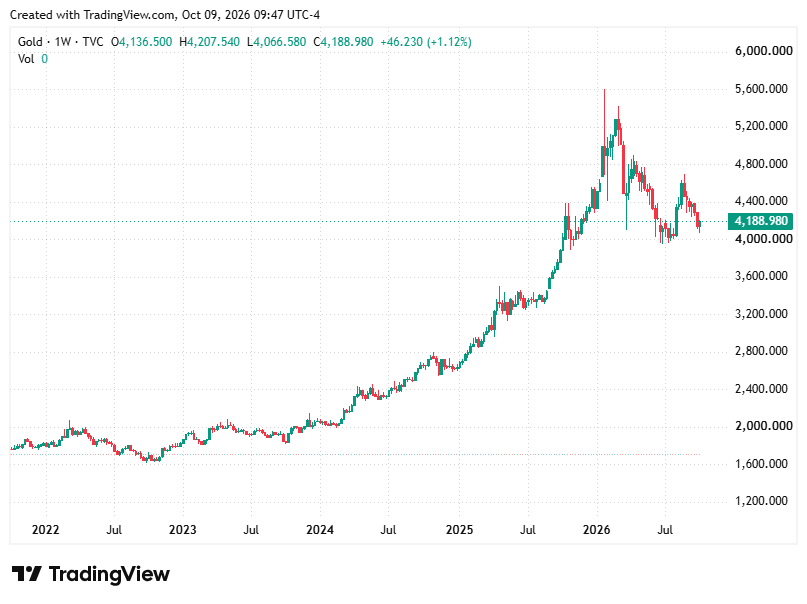
The graph puts gold’s recent movements into a longer-term perspective. Short-term declines are part of the picture, but the broader rise over the past five years is the focus of this MacroXX article. The chart shows how prices have changed; understanding why requires looking beyond the line to economic conditions, geopolitical tensions, and changing demand for financial security.
The familiar explanation: inflation and interest rates
The conventional explanation for gold starts with a simple fact: gold pays no interest.
When inflation-adjusted interest rates rise, investors can earn more from interest-bearing assets, making gold relatively less attractive. When those rates fall, gold’s disadvantage becomes smaller. A weaker dollar and concerns about inflation can also support demand.
These relationships remain important. But they do not explain everything.
The European Central Bank noted that increased demand for gold had disrupted its familiar negative relationship with long-term real interest rates. In plain language, gold was receiving support that the usual interest-rate framework did not fully capture.
This is where the geopolitical explanation becomes useful.
An individual investor might ask, “Which asset offers the best return?”
A government managing its national reserves must ask another question: “Will we still be able to access these assets if relations with another country break down?”
Those are different questions. They can lead to different decisions.
Sanctions changed the meaning of financial safety
A country’s foreign reserves serve as a financial safety cushion. But an asset’s safety depends on more than its price or the likelihood that its issuer will repay it. Safety also depends on whether the owner can access it.
Russia’s full-scale invasion of Ukraine in February 2022 brought that distinction into sharp focus.
The United States and its partners immobilized Russian central-bank assets held within their jurisdictions. The European Parliament estimated the amount at roughly €260 billion, with most held in the European Union.
These measures responded to Russia’s aggression. Their implications, however, extended beyond Russia.
Other governments could see that reserves held abroad might become inaccessible during a severe political conflict. An asset could remain valuable on paper while its owner lost the ability to use it.
Physical gold held domestically has a different character. Unlike a bond or a bank deposit, bullion is not another institution’s promise to pay. The ECB identifies this absence of a counterparty liability as one of gold’s distinctive attractions.
Gold is not completely sanctions-proof. Selling it, transporting it, or converting it into internationally usable funds can still depend on institutions and market access. Nevertheless, domestically held bullion reduces dependence on a foreign issuer or custodian.
For MacroXX, this distinction is central: gold can provide protection against restrictions on access to wealth, not just against declining purchasing power.
The global economy has pressure points
Globalization connected countries through finance, technology, and trade. But those connections are not evenly controlled.
Financial transactions, advanced technology, and critical supply chains often depend on networks with few easy substitutes. Governments that control important parts of those networks can use them to exert pressure. Systems designed to make the world economy more efficient can also become instruments of economic coercion.
The dollar-based financial system is an important example.
International banks depend heavily on access to dollar finance and the US financial system. That gives Washington leverage: institutions may have to choose between doing business with a sanctioned country and preserving access to a much larger financial network. US sanctions against Iran demonstrated how powerful that choice can be.
But the ability to apply pressure creates an incentive for others to prepare against it.
Governments concerned about becoming future targets may seek alternative payment channels, adjust trading relationships, or diversify their reserves.
Gold fits into that broader search for financial resilience.
China and the United States: a contest over economic dependence
The rivalry between China and the United States extends beyond military power or the size of their economies. It also involves control over technology, supply chains, and the systems on which other countries depend.
The United States and its allies have restricted China’s access to advanced semiconductors and chipmaking equipment. China has demonstrated its own leverage through restrictions involving rare-earth minerals. Both sides are using concentrated economic strengths as strategic tools.
This matters because economic restrictions can become enduring when their purpose shifts from changing a particular policy to limiting a rival’s capabilities.
A temporary disagreement can become a long-term contest. Countries then have stronger incentives to build alternatives and reduce vulnerable dependencies.
The connection to gold is indirect but important.
If governments expect strategic competition to last for years, they have a reason to reconsider how they hold their reserves. Gold can become part of an effort to reduce exposure to foreign-controlled financial networks.
This does not require abandoning the dollar altogether. Building a fallback option is different from replacing an entire system.
BRICS and the search for alternatives
BRICS belongs in this discussion because its members have pursued greater use of local currencies and cooperation on cross-border payments. These efforts include improving connections between national payment systems and facilitating transactions in members’ own currencies.
The motivation fits the broader story: some governments want more options and less dependence on existing financial channels.
But MacroXX draws a distinction between that ambition and the claim that BRICS has already created a functioning gold-backed replacement for the dollar.
More local-currency trade, alternative payment arrangements, and larger gold holdings are separate developments. They should not be treated as interchangeable evidence of a new common currency.
Gold does not need a successful BRICS currency project to benefit from geopolitical uncertainty. Its appeal can increase simply because individual countries want to diversify their reserves.
The more useful interpretation is gradual diversification and fragmentation—not an overnight monetary revolution.
What central-bank buying tells us
Official demand provides evidence for this interpretation.
Central banks purchased more than 1,000 tonnes of gold in each of the three years preceding 2025. Purchases slowed to 863 tonnes in 2025, but remained historically elevated and geographically widespread.
The ECB linked increased purchases by emerging-market central banks to concerns about geopolitical tensions and possible sanctions.
Meanwhile, the World Gold Council’s 2025 central-bank survey identified crisis performance, diversification, and inflation hedging as important reasons for holding gold.
These motives overlap. A reserve manager can worry about inflation, financial instability, and political vulnerability at the same time.
Buying gold therefore does not necessarily mean a country expects the dollar to collapse. It may reflect a more practical judgment: the country does not want its entire financial safety cushion exposed to the same risks.
In this setting, diversification is partly about independence.
The complication: geopolitics cannot explain everything
A persuasive argument must acknowledge evidence that complicates it.
Central-bank purchases fell by 21% in 2025, even as gold prices rose sharply. Meanwhile, global gold ETF holdings increased by about 801 tonnes, and investment demand strengthened. Safe-haven demand, diversification, and the attraction of rising prices all contributed.
That means we cannot explain the entire rise by saying, “Central banks bought more gold.”
A better interpretation separates the underlying foundation from the forces that accelerated the move:
Sustained official buying helped establish a strong base of demand.
Geopolitical and economic-policy uncertainty increased gold’s safe-haven appeal.
Private investors added exposure through ETFs, bars, and coins.
Macroeconomic conditions, including dollar weakness and expectations of lower interest rates, also supported prices.
These forces can reinforce one another.
A trade conflict, for example, can raise concerns about inflation, growth, supply chains, and international relations at the same time. Separating “macroeconomics” from “geopolitics” is useful for analysis, but the real world does not keep them neatly apart.
The MacroXX hypothesis is therefore best understood as a shift in emphasis: geopolitical concerns have become a structural source of demand, rather than merely a temporary reaction to frightening headlines.
A changing global order—and a changing definition of security
The larger story is about trust.
When economic connections become tools of political pressure, countries respond defensively. They try to reduce their dependencies, develop alternative networks, and protect themselves against future restrictions. Over time, those responses can weaken the trust that made deep economic integration possible.
For readers of MacroXX, gold offers a window into that changing environment.
Gold is not issued by a rival government, and physical bullion is not another institution’s liability. But it still has disadvantages: its price can fall, storage brings costs, and it pays no ordinary interest income. Financial independence is not the same thing as a guaranteed investment return.
The longer-term rise in gold is therefore consistent with a world in which governments and investors increasingly value resilience alongside returns.
The question is no longer only, “What will my money buy?”
It is also, “Who controls the system in which I hold it?”
This article is for educational and informational purposes only and should not be considered investment advice.